What Are the 4 Key EU Blockchain Initiatives that You Should Know? (Part 1)
Matthew Lam May 06, 2019 09:00
The EU has been active in fostering blockchain technology in 2019. Here are the 4 key blockchain initiatives in EU that you should know!

The European Union (EU) released a factsheet to reflect the state of blockchain adoption in April. According to the EU Observatory, 400 blockchain initiatives of start-ups and non-profit organizations in the EU raised ca. EUR 200 mn from ICOs and EUR 115 mn from private equity.
In terms of blockchain adoption in Europe, over a quarter of blockchain applications goes to IT and telecom industry, followed by government services (19%) and financial services (14.9%) (See Exhibit 1).
Exhibit 1: State of European Blockchain Adoption By Sector
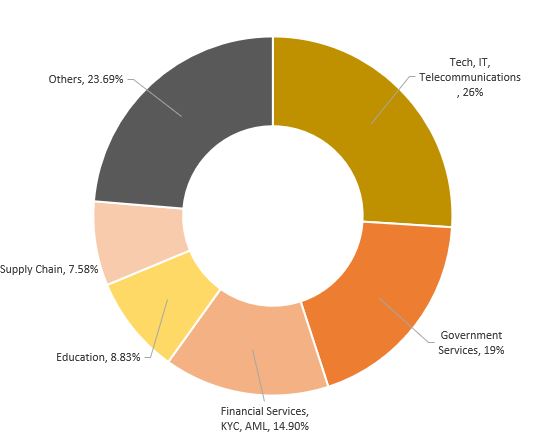
Source: European Blockchain Observatory and Forum April 2019, based on self-declarations by 400 startups and other blockchain initiatives
The EU has been active in fostering blockchain technology in 2019. Here are the 4 key blockchain initiatives in EU that you should know!
1) The International Association of Trusted Blockchain Applications (INATBA)
The EU announced the launch of INATBA in Brussels on 3 April. According to Mariya Gabriel, the Commissioner for the Digital Economy and Society of the European Commission (EC), the European efforts to foster DLT will be ineffective if they are not compatible with blockchain solutions elsewhere in the world. Hence, Gabriel highlighted the launch of the INATBA with the 3 main purposes:
a) Promote an open, transparent and inclusive global model of governance for blockchain and other DLT;
b) Support adoption of sector-specific and interoperability guidelines; and
c) Establish a dialogue with public authorities and regulators at a global scale
In short, INATBA aims to develop a framework that promotes public and private sector collaboration, regulatory convergence, legal predictability and ensures the system’s integrity and transparency.
There are 105 founding members in INATBA at its launch date, which includes traditional giants such as IBM, Accenture and Deutsche Telekom. Besides, a number of crypto-related organizations also joined the INATBA, including Iota, Ripple and ConsenSys. Besides, 48 additional organizations applied for memberships at the launch date of the INATBA.
2) Horizon 2020
Horizon 2020 is the biggest EU Research and Innovation programme, which is a part of the Europe 2020 flagship initiative to secure Europe’s global competitiveness. The programme has 18 thematic sections, including the key ones such as Excellent Science (contains section of future and emerging technologies), Industrial Leadership in Technologies and Societal Challenges.
To date, the EU has contributed EUR 40.91 bn in supporting Horizon 2020. If we look at the contributions by countries, it is interesting to see that Germany (16%), the United Kingdom (14%) and France (11%) have made over 40% of the total contributions (See Exhibit 2).
Exhibit 2: Contributions to Horizon 2020 by Top European Countries
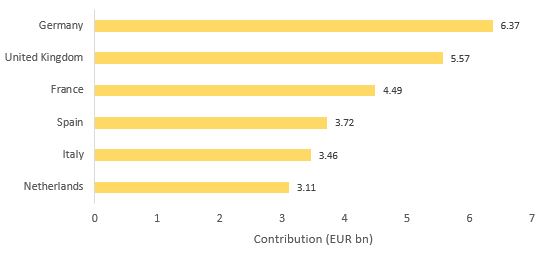
Source: The European Commission, Blockchain.News Data
Breaking down the EUR 40.91 bn into organization types, it’s a bit surprising to know that higher and secondary education accounted 39% of total, followed by Private for Profit (excl. education) and research organizations (See Exhibit 3). The French National Centre for Scientific Research (CNRS) topped the list with EUR 712 mn contributions. It is worth noting that the Chancellor Masters and Scholars of the University of Cambridge and University of Oxford made over EUR 300 mn contributions respectively.
Exhibit 3: Contributions to Horizon 2020 By Organization Types
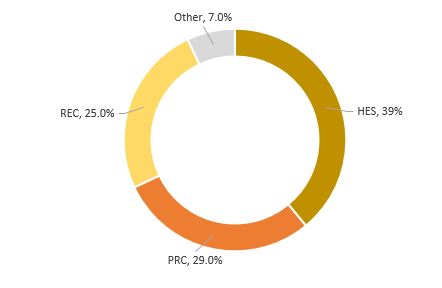
Note:
HES: Higher or Secondary Education
PRC: Private for Profit Corporation (excl. education)
REC: Research Organizations
Source: The European Commission, Blockchain.News Data
The EU has allocated EUR 141 mn to support R&I in Blockchain/Distributed Ledger Technology (DLT) through Horizon 2020, which the amount of committed capital can be up to EUR 300 mn by 2020. Under the Leadership in Enabling and Industrial Technologies (LEIT) research programme, a Collective Awareness Programs for Sustainability and Social Awareness (CAPS) has pioneered research on blockchain technologies.
Image source: Shutterstock.jpg)