News
The $42 Billion Gamble: Why MicroStrategy Refused to Sell During the December BTC Drawdown
While the rest of the market was panic-selling during the great December 2025 "Reset," Michael Saylor and MicroStrategy did the opposite: they bought more. By leaning into their "21/21 Plan," the company proved that its $42 billion bet on Bitcoin isn't just a strategy, it is a conviction that defies traditional Wall Street gravity.
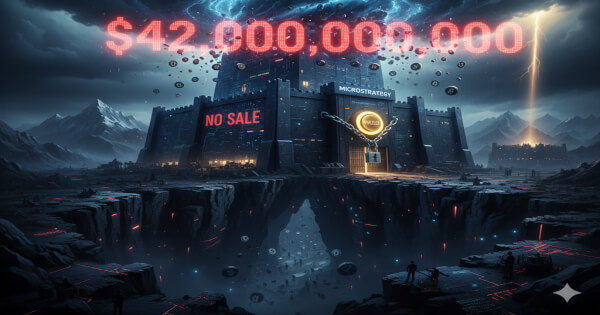
In the world of corporate finance, there is a "rule" that most CEOs follow: if your main asset drops 30% in a month, you sell a little to protect your skin. But Michael Saylor, the Executive Chairman of MicroStrategy (MSTR), doesn't play by the rules of the old world.
As Bitcoin hit the $94,000 glass ceiling in December 2025 and tumbled back toward the $70,000 range, critics expected MicroStrategy to finally flinch. Instead, the company doubled down on its "$42 Billion Gamble."
The 21/21 Plan: A Wall of Digital Capital
To understand why they didn't sell, you have to understand the "Wall of Money" they built in late 2024. The "21/21 Plan" was a three-year mission to raise $42 billion:
- $21 Billion in Equity: Selling new shares of the company.
- $21 Billion in Debt: Issuing fixed-income securities (convertible notes).
By the time the December 2025 crash hit, MicroStrategy had already hoarded over 700,000 BTC. They weren't just a software company anymore; they were a giant "Refinery" that took old-fashioned fiat currency and "refined" it into digital gold. Selling even one Bitcoin would have been like a refinery throwing away its gold—it would have broken the entire business model.
The "Unsinkable" Debt Structure
The biggest misconception during the January 2026 "mini-winter" was that MicroStrategy was about to face a "margin call." On social media, people were terrified that if Bitcoin dropped low enough, Saylor would be forced to sell.
The Reality Check: Unlike a retail trader using 10x leverage on an exchange, MicroStrategy’s debt is long-term and unsecured.
- No Margin Calls: Their lenders cannot "call" the loan just because the price of Bitcoin is down.
- Zero Interest (mostly): Much of their debt consists of convertible notes with 0% or near-zero interest rates.
- Maturity Dates: Most of these loans don't need to be paid back until 2027, 2028, or later.
Saylor isn't a gambler at a roulette table; he’s a homeowner with a 30-year fixed mortgage who doesn't care if the house price dips for a few months.
The January "Discount" Phase
By late January 2026, the panic reached a fever pitch. MSTR stock plummeted nearly 70% from its record highs. For a brief moment, the stock was actually trading at a discount to its Net Asset Value (NAV). > "Saylor is the only captain who sees his ship sinking and decides to buy more of the ocean." — Anonymous Wall Street Trader
Instead of selling, MicroStrategy used its remaining cash to buy another $116 million worth of Bitcoin in early January 2026, even while they were technically sitting on "paper losses." This was a signal to the world: the company believes the $94,000 rejection was a temporary glitch, not the end of the 2026 bull market.
The Result: A "Bitcoin Yield" Machine
As we move through February 2026, the "gamble" is starting to look like a masterstroke again. Because they didn't sell, their "Bitcoin Yield"—a metric Saylor uses to show how much Bitcoin they own per share—actually went up.
By refusing to sell, MicroStrategy has effectively turned itself into a permanent "HODL" fund that the world’s biggest banks are now forced to deal with. They didn't just survive the December drawdown; they used it to prove that their "Digital Capital" strategy is immune to the "paper hands" of the traditional market.
Sources: Investopedia: Michael Saylor and Strategy Go Under the Microscope, Binance Square: Saylor Hints at New Bitcoin Purchase Dec 2025, CoinMarketCap: MicroStrategy Unveils Aggressive $42 Billion Plan, Barchart: MicroStrategy Stock Down 70% from Record Highs