News
39% of US Merchants Accept Crypto as Casino Deposits Evolve
Crypto payments are no longer a side note in digital commerce. Users today are far more used to seeing the familiar symbols for the mainstream coins when they make payments, and this presents a challenge for entertainment providers: how do they retain clarity and ensure payment pages are as intuitive as possible while offering plenty of choice?

Image source: Bespoke illustration created by the author for this piece
Crypto payments are no longer a side note in digital commerce. Users today are far more used to seeing the familiar symbols for the mainstream coins when they make payments, and this presents a challenge for entertainment providers: how do they retain clarity and ensure payment pages are as intuitive as possible while offering plenty of choice?
A January 2026 PayPal and National Cryptocurrency Association survey found that 39% of U.S. merchants already accept cryptocurrency at checkout, while 84% believe crypto payments will become common within 5 years. That figure shifts the conversation from novelty to usability. Readers are asking how payment moves, where approval happens, and what to read next.
The Deposit Moment Is Now Part of Product Understanding
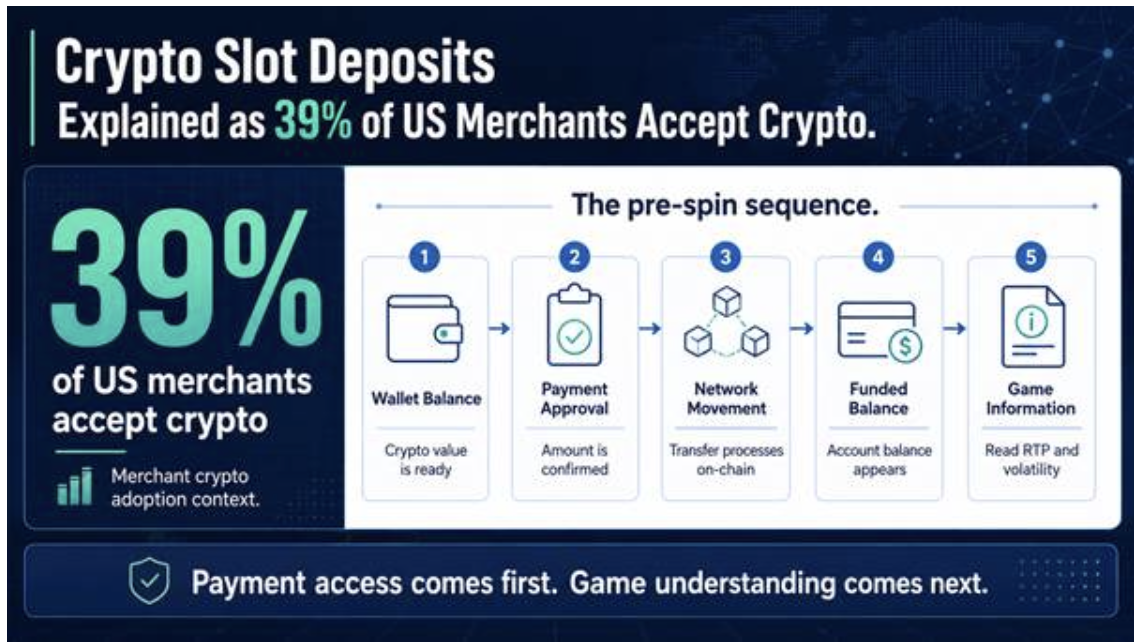
Image source: Custom graphic created by the author for this article
A crypto slot deposit has two separate layers: the payment route and the game information that appears once the balance is ready. Jiggle Pay is a good example because it simplifies the wallet-to-cashier moment. This guide to Bitcoin slots with Jiggle explains Jiggle as a self-custody crypto wallet connected to Jiggle Pay, where users can start from the cashier, enter an email and amount, sign in to the Jiggle Wallet, and approve the deposit through a payment link. It also states that deposits move on the Litecoin network, which keeps the technical description accurate: this is a crypto payment route into slot play, not a claim that every part of the process is Bitcoin-only.
Once the balance appears, folks playing Bitcoin slots with Jiggle turn their attention to the second layer: check the slot information screen before treating the session as ready. RTP, volatility, feature type, and bonus options all belong to that second layer.
The short explainer on RTP and volatility continues from that exact point. It defines RTP as the long-term percentage listed for a game, then separates that from volatility, which describes how uneven the experience can feel over shorter sessions. Its most useful detail is the bonus buy note: a game may list a separate bonus buy RTP, and higher-tier feature options can carry greater volatility. That turns the post-deposit moment into a knowledge step.
The payment backdrop is larger. In April 2026, Chainalysis estimated that stablecoins processed $28 trillion in real economic volume in 2025, after adjusting for activity that does not represent ordinary economic use. That figure shows why clearer payment education matters. More volume means more users meeting payment flows where timing, confirmation, and clarity matter.
Reading the Pre-Spin Flow
1. Wallet Balance
A crypto slot session starts with value ready in a wallet. The useful detail is where the balance sits before payment begins, not just which coin is being used.
2. Wallet Approval
Approval is the active payment moment. The player confirms the amount through the wallet or payment route, making the deposit a clear action, rather than an unseen transfer.
3. Network Movement
After approval, the payment moves across a blockchain network. Timing and fees can vary by route.
4. Funded Balance
When the account balance updates, the session shifts from payment access to game selection. The deposit is complete.
5. Game Information
RTP, volatility, bonus features, and feature costs belong here. The cleaner habit is to understand the payment route first, then read the slot details before play begins. Smooth wallet approval explains access. RTP and volatility explain how the game is built once the balance is ready.
Why Payment Clarity Changes the First Decision
The first question after funding is not always which button to press. It is often whether the reader understands the information already visible on the game screen. A slot can be easy to access while still requiring a careful read of its details.
RTP is best understood as a long-term percentage, not a short-session forecast. Volatility describes how the experience may be distributed across play, especially when bonus features or bonus buy options are involved. A standard feature and a higher-tier feature can sit in the same game with different session movement.
That distinction is useful because crypto payment flows can feel immediate. When a wallet approval works smoothly, the funded balance can make the next step feel obvious. The better habit is to pause on the information screen and read what the game is showing. Fast access and informed reading work together.
The Clearer Standard for Crypto Slot Content
The PayPal figure gives this topic its wider context: crypto payments are becoming more familiar at checkout. The Chainalysis figure gives us insight into the bigger picture of how cryptocurrencies are being used. For crypto slot readers, the useful version is concrete: wallet, approval, network, funded balance, game information.